


Now in its 12th year in business, ISA is not just readying its 28th megayacht to date for launch this year, but also weathering the economic crisis. To be sure, the global meltdown has hit even long-established megayacht builders hard, but it’s arguably easier to start bouncing back when a company has decade after decade of history behind it. Compared to those companies, ISA, based in Ancona, Italy, is still quite young. The way ISA and its management team approach the megayacht market speaks volumes about why it’s still here.
ISA started as a proverbial blank sheet of paper. Marcello Maggi (pictured), its co-founder, had several years of experience at CRN, plus a keen business sense stemming from a degree in economics. Even with that, though, ISA needed to prove its capabilities in a market with far more established builders. Its first megayacht was therefore built on spec. That yacht, the 155’8” (47.5-meter) April Fool, sold within a few months, turning heads as much for her fit and finish as for the dual curving staircases that flowed the length of her aft decks.
Fast forward to today, and Maggi points to a few reasons why it has succeeded. For one, ISA takes a conservative approach toward systems and technology. “We’re not going to be a guinea pig, and we won’t make our clients one,” Maggi says. Another, even bigger reason, though, is repeat business. “Today’s climate does not allow for an unhappy client,” he underscores, adding that ISA strives to provide all-around service, from reliability of new builds to refit and repair work. Presently, there are two 164-footers (50-meters) built by ISA undergoing winter work on site, for example. They’re owned by clients who take their yachts to the shipyard regularly for this. In addition, four repeat clients have new megayachts under construction. There’s even one repeat broker who has returned with a new client for a build project.

Among those new-construction projects are a 134’5” (41-meter) yacht, the first of ISA’s Classic 41 Meter series. The trideck megayacht has a steel hull and aluminum superstructure, quite a departure from the industry norm of fiberglass in this size and style. Maggi believes there’s a niche for the approach, appealing to buyers who want the long-range and volume advantages of larger yachts in a more manageable size. The Classic 41 Meter should cruise at 13 knots and top out close to 14.5 knots with Caterpillar C18 engines. C32s are available, too, promising a top end closer to 16 knots. Hull number one will debut at September’s Monaco Yacht Show.
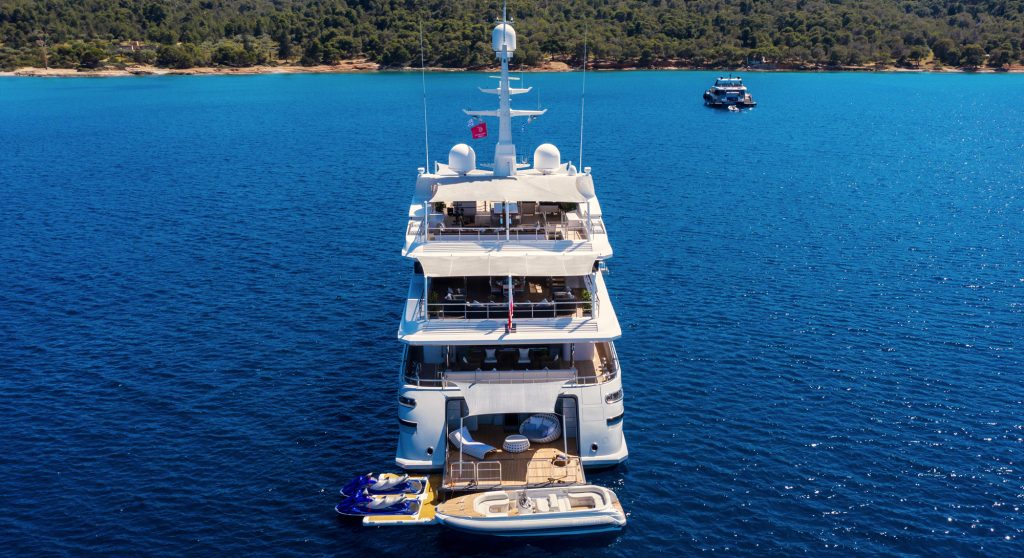
Another project under construction: a 216’5” (66-meter) Granturismo for completion in 2014 (above). “This is a project a lot of people are going to talk about,” Maggie avers, and he’s right. ISA developed the Granturismo series as direct result of the economic crisis, to attract the buyers who weren’t satisfied with the status quo. It emphasizes the outdoor experience of a small cruiser but in a far larger package. The indoor-outdoor dining area aft on the main deck, the large windows, and the higher-than-usual overheads all contribute to the feel. Other highlights: an infinity pool, a cinema on the upper deck, a glass-enclosed gym, and a master suite akin to a penthouse apartment.
For the future, Maggi echoes the sentiments of many in the industry when he says he’s keeping an eye on emerging markets like China. But, he also believes the North American market will bounce back well before China starts producing regular buyers. Maggi further believes that while the 131- to 164-foot (40- to 50-meter) market segment is generally gaining strength, the 197- to 230-foot (60- to 70-meter) segment is particularly strong for ISA. He also sees potential larger than that, stating, “We structured the yard to build to 100 meters,” a.k.a. 328 feet. A shed and a Syncrolift capable of handling something of that magnitude can each be added when needed. Maggi stresses that ISA will make the investments if a client wants to build in that size range.
It’s a nice position to be in for ISA: not having to push a product, like in the early days.




Leave a Reply